

The Nigerian Airspace Management Agency (NAMA) has urged the National Assembly to approve a new statutory framework that would allow it to retain 90 per cent of Aviation Height Clearance (AHC) technical service fees, arguing that the Agency performs the specialised safety assessments behind every clearance but receives no dedicated payment.
The Agency also wants lawmakers to increase its share of the existing five per cent Ticket, Charter and Cargo Sales Charge (TSC) from 22 per cent to 56 per cent. According to NAMA, the proposal will not increase charges on passengers. Instead, it will redistribute existing revenue to match the Agency’s expanding safety responsibilities.
AHC: NAMA Seeks 90% Fee Share, 56% TSC Allocation
Aviation Height Clearance (AHC) is the approval required before tall structures such as telecommunications masts, high-rise buildings, cranes and towers can be erected to ensure they do not endanger aircraft operations. While the Nigerian Civil Aviation Authority (NCAA) issues the clearance certificate, the Nigerian Airspace Management Agency (NAMA) conducts the technical assessments, including obstacle surveys and analyses, to determine whether a proposed structure could interfere with flight paths, navigation aids, radar or protected airspace.
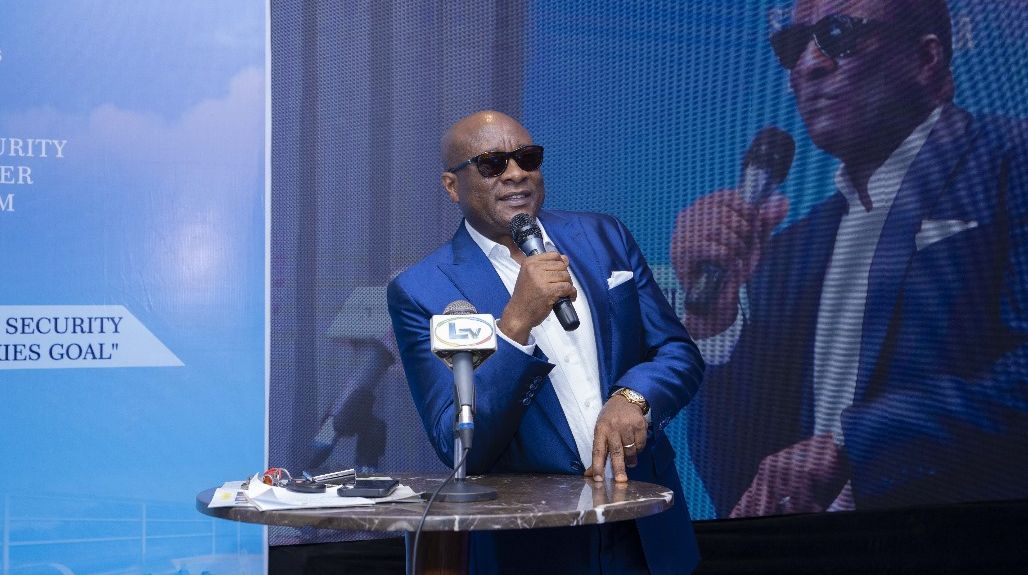
Speaking at the public hearing on the proposed revision of the statutory sharing formula for the five per cent Ticket, Charter and Cargo Sales Charge and statutory mandate for obstacle evaluation charges, the Managing Director of NAMA, Engr. Farouk Ahmed Umar, said AHC should recognise the Agency’s technical role in protecting Nigeria’s airspace.
He explained that while the Nigerian Civil Aviation Authority (NCAA) issues Aviation Height Clearance certificates, NAMA carries out the operational evaluations that determine whether proposed structures pose risks to aircraft operations.
“The aeronautical question is operational,” Umar said. “Will a proposed mast, tower, crane or high-rise building interfere with a flight procedure, minimum altitude, navigation aid, surveillance system or protected airspace? NAMA performs this safety-critical technical work but receives no dedicated payment for the service.”
According to him, AHC should reflect the technical expertise required to conduct obstacle assessments, WGS-84 survey validation, procedure-impact analysis and field inspections.
“NCAA should retain the regulatory component of the Aviation Height Clearance. NAMA should be paid the identified technical-services component for WGS-84 survey validation, obstacle assessment, procedure-impact analysis and field work,” he said.
He added that the Agency was proposing a 90:10 sharing formula in its favour because the revenue would sustain specialised equipment, digital mapping capability, software, survey systems and highly trained personnel required for AHC services.
“We are therefore recommending a sharing formula of 90 per cent to 10 per cent in favour of NAMA,” Umar stated, noting that the proposal aligns with the International Civil Aviation Organization’s cost-recovery model for technical services.
Meanwhile, the NAMA Managing Director argued that the Agency’s request for a larger share of the TSC pool was equally necessary to ensure sustainable funding for Nigeria’s air navigation infrastructure.
“I appear before you with respect for every institution supported by the five per cent ticket, charter and cargo sales charge,” he said. “Our submission does not diminish any of these truths. It asks only that the law also recognise, in a practical and sustainable way, the scale of the responsibility placed upon NAMA.”
Explaining the proposal, Umar stressed that the TSC itself would remain unchanged. Instead, the amendment would only alter how the existing revenue is shared among aviation agencies.
“Today NAMA receives 22 per cent of the five per cent statutory pool,” he said. “On every ₦1,000 of qualifying ticket, charter or cargo sales, the five per cent charge produces ₦50. NAMA receives ₦11 from that ₦50. Our effective share is therefore 1.10 per cent of the underlying sale.”
He continued: “If this number is changed to 56 per cent, NAMA would receive ₦28 from the same ₦50. The five per cent charge itself would not increase. The passenger would not be asked to pay a sixth per cent. The amendment would simply direct a fairer share of the existing pool to the infrastructure that guides the aircraft.”
According to Umar, AHC and sustainable funding have become increasingly important because the Agency’s operating costs continue to rise while key revenue streams have remained largely unchanged.
He recalled that publicly reported figures for 2023 showed personnel expenditure of about ₦21 billion, capital spending exceeding ₦12 billion and overhead costs above ₦10 billion.
“These are not abstract numbers,” he said. “Behind them are controllers, engineers, communication systems, navigation aids, surveillance platforms, power systems, spares, software, calibration, training and facilities spread across our country.”
In addition, Umar noted that the navigation charge of about ₦11,000 per flight had remained unchanged since June 2008 despite rising costs of electricity, foreign exchange, imported components, software licences and specialist training.
“The service has had to absorb today’s costs with yesterday’s tariff base,” he said. “The dedication of our workforce has helped bridge that gap, but dedication is not a substitute for a sustainable funding system.”
He also warned that Nigeria’s ageing surveillance infrastructure requires sustained investment to avoid future operational risks.
“Our surveillance infrastructure has served the country over many years,” he said. “Responsible management does not wait for obsolescence to become failure. It plans replacement, builds redundancy, trains the people who will operate the new system and keeps the old and new services safely coordinated during transition.”
Therefore, Umar appealed to lawmakers to harmonise existing legislation governing NAMA’s funding. He pointed out that the Civil Aviation Act allocates 22 per cent of the TSC to the Agency, while the NAMA Act refers to 23 per cent.
“The law should speak with one voice,” he said. “The beneficiaries should be named correctly; the percentages should total 100 per cent; collection and remittance responsibilities should be unambiguous; and the effective date should be clear.”
He assured stakeholders that increased funding through AHC and the revised TSC formula would be matched with stronger transparency and accountability.
“NAMA is not asking the National Assembly for a blank cheque,” Umar said. “We support automated collection and remittance, quarterly disclosure of receipts and projects, annual independent audit, transparent procurement and measurable performance indicators.”
The Managing Director concluded that strengthening AHC and revising the TSC allocation would ultimately improve the safety, efficiency and resilience of Nigeria’s airspace.
“Give us the means and hold us to the result,” he said. “Give Nigerian airspace the resilience it requires and require us to demonstrate that resilience. In doing so, this National Assembly will not simply amend a percentage. It will strengthen the safety, efficiency, sovereignty and future competitiveness of our nation’s airspace.