


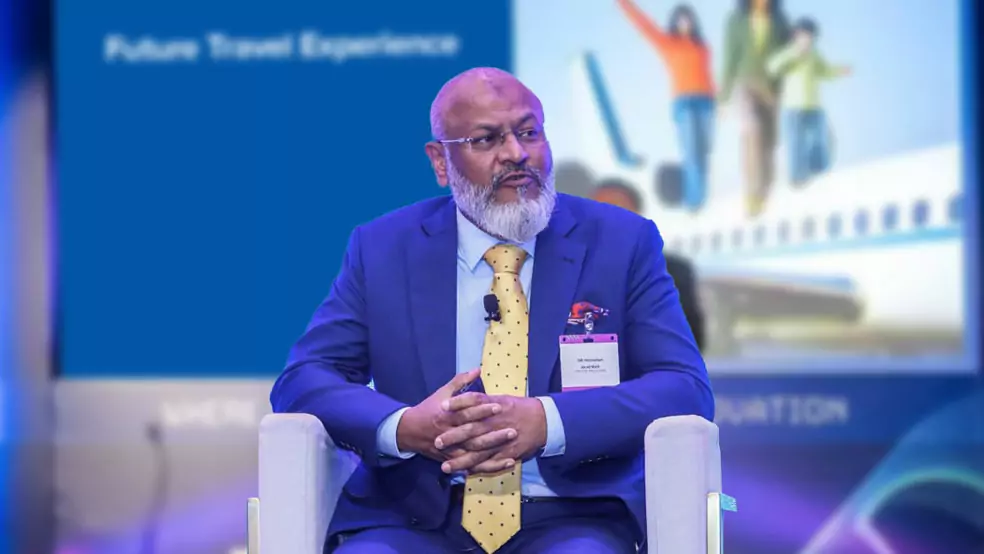

At the just-concluded Ethiopian Aviation Forum held at the Ethiopian Skyline Hotel, Aviation C-Suite Executive, Javed Malik delivered a hard-hitting technical assessment of how smart airports should be designed and operated. His presentation focused on throughput efficiency, long-term execution, and the dangers of copying global technology trends without contextual planning.
He argued that airports are not defined by visible digital systems alone. Instead, they are defined by how efficiently passengers, processes, and infrastructure interact. Malik stressed that many airport projects fail because they prioritise branding and technology adoption over operational reality and actual passenger flow.

Smart Airports Must Prioritise Throughput and Functionality
Mr. Malik explained that the foundation of smart airports lies in processing capacity rather than technology aesthetics. He noted that systems must enhance flow instead of creating bottlenecks or unnecessary complexity.
He stated clearly: “Processing capacity is leveraged and maximised with appropriate technology.”
However, he warned that many operators misinterpret this principle. In pursuit of smart airports, they adopt global trends without analysing local conditions. This often leads to inefficiency rather than improvement.
Malik revealed that he currently supports airport operations across Saudi Arabia, noting: “I am supporting 18 airports in Saudi Arabia at the moment.”
He highlighted that biometrics, often seen as a hallmark of smart airports, were widely implemented without proper contextual design. In many cases, the technology did not reflect passenger demographics or operational realities.
He explained: “They introduced biometrics because everybody is doing biometrics.”
However, the outcome was flawed. In several airports, facial recognition systems struggled because a significant number of passengers wore face coverings. This made standard biometric verification ineffective and slowed passenger movement instead of improving it.
He observed: “In 13 of those airports, they have 100% hijab, niqab-wearing ladies. How does biometrics work for those ladies?”
The misalignment, he argued, led to wasted investment and operational inefficiency in systems marketed as smart airports solutions.
Malik disclosed the financial scale of the error:
“They had spent more than $30 million on e-gates and biometric solutions.”
He added that poor planning led to avoidable losses, stressing that technology without context is not innovation. Instead, it becomes a costly operational burden for smart airports programmes.
A central theme in Malik’s presentation was his philosophy of “Bytes Not Bricks,” which advocates digital optimisation over physical expansion in building smart airports.
He stated: “It’s not about doing technology for the sake of technology.”
He emphasised that smart airports must adopt technology suited to their specific environment, not imported blindly from other regions.
He added: “You don’t need to build out. Use technology. But use appropriate technology for your region.”
Malik warned that copying international airport models without adaptation leads to wasted capital and weak operational performance. For emerging aviation markets, especially in Africa, he argued that smart airports must be built around regional realities, not global assumptions.
Japan as the Benchmark for Smart Airports Execution
Malik pointed to Japan as the global benchmark for execution discipline in building smart airports and complex infrastructure systems.
He said:
“The best executors of plans and process improvement are the Japanese.”
He praised their precision in planning, long-term thinking, and operational discipline. According to him, smart airports succeed only when design is matched with rigorous execution and system readiness.
He further stressed the importance of Operational Readiness and Airport Transfer (ORAT), a critical phase often overlooked in airport development.
He explained that many smart airports fail at launch because systems are not tested under real-world conditions involving both passengers and staff behaviour.
Lessons from a $25 Billion Smart Airports Transition
Aviation C-suite executive Javed Malik also shared his experience managing a major airport transition project valued at $25 billion. He described the complexity of moving from an old airport system to a highly advanced smart airports facility.
He said: “I was responsible for the entire move from the old airport to the new.”
He highlighted that operational readiness is not only about infrastructure, but about human adaptation at scale within smart airports environments.
He revealed that he trained 9,000 workers over a year to prepare them for new systems and workflows.
He stated: “I spent one year teaching 9,000 people.”
Interestingly, he clarified that training was not focused on aviation operations but on adapting to advanced facilities.
He explained: “They did not need to learn how to load aircraft… but how to use the toilet facilities.”
The new airport included advanced features such as digital taps, biometric lockers, and automated systems. However, Malik warned that without behavioural readiness, even the most advanced smart airports can fail at launch.
Building Smart Airports for People, Not Just Infrastructure
Concluding his intervention at the Ethiopian Aviation Forum, Aviation C-suite executive Javed Malik stressed that Africa and emerging aviation markets must balance infrastructure development with human readiness.
He said: “Build, but build smartly and bring the people with you.”
He emphasised that smart airports must evolve alongside training systems, ensuring that both staff and passengers are prepared for digital transformation.
Ultimately, Malik’s message reinforced a central truth: smart airports are not defined by how advanced they look, but by how effectively they function in real-world conditions where people, systems, and technology must align seamlessly.





Hi, the published interview incorrectly identifies Javed Malik as the Chair of Ink Innovation’s Advisory Board. Please note that Mr Malik stepped down from his advisory role at Ink last year. Could you please update his role. Thanks
Good day. Please note that the intro referring to him as Chair of Ink Innovation’s Advisory Board has been expunged from the report and updated. Thank you for that correction. Although, he was referred to as such during the Ethiopian Forum Meeting.