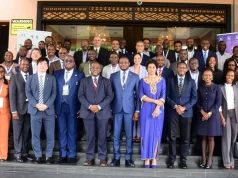


Minister of Aviation and Aerospace Development, Festus Keyamo, has called for increased investment in human capital to strengthen Air Traffic Management across Africa.
He made this known while delivering his keynote address at the opening ceremony of the 36th International Federation of Air Traffic Controllers’ Associations (IFATCA) Africa and Middle East Regional Meeting in Victoria Falls, Zimbabwe.

Keyamo stressed that well-trained and motivated air traffic controllers are vital to improving Air Traffic Management and ensuring safer skies across the continent.
According to a statement signed by his Special Adviser on Media and Communications, Tunde Moshood, the Minister emphasized the need for strategic recruitment, training, and retention of skilled professionals to enhance airspace safety and operational efficiency.
Speaking under the conference theme, “Securing the Skies: Strengthening Air Traffic Management Capacity through Strategic Recruitment, Training, and Retention,” Keyamo said Africa must prioritise people as much as technology in developing robust Air Traffic Management systems.

He said the African airspace continues to experience rapid expansion and operational complexity, requiring better-equipped professionals to manage it safely.
“Across our region, we face rising complexity in operations and higher expectations from the travelling public. To meet these challenges, we must invest not only in technology, but more importantly, in people. It is the professionalism, alertness, and dedication of air traffic controllers that keep millions of passengers safe every single day,” Keyamo stated.
The Minister reaffirmed Nigeria’s commitment to aviation safety and human capacity development under President Bola Ahmed Tinubu’s Renewed Hope Agenda. He noted that through the Nigerian Airspace Management Agency (NAMA), the Federal Government is modernising its Communication, Navigation, and Surveillance/Air Traffic Management systems.
Keyamo added that training pipelines for air traffic controllers are being expanded, while programmes supporting mental wellbeing and peer mentorship are being institutionalised to promote excellence in Air Traffic Management operations.
He also highlighted Nigeria’s collaboration with regional organisations such as the Banjul Accord Group Aviation Safety Oversight Organisation (BAGASOO) to accelerate Air Navigation Service Provider (ANSP) certification, improve safety oversight, and entrench a culture of safety across all aviation activities.
“We must remember that aviation is a shared ecosystem. Its strength lies in collaboration among States, regulators, ANSPs, and professional bodies like IFATCA. Our skies know no borders; therefore, our success must also be borderless, built on shared knowledge, shared responsibility, and shared resolve,” he said.
Keyamo commended IFATCA for its consistent advocacy for professionalism and the welfare of air traffic controllers globally. He also appreciated the Government and people of Zimbabwe for their warm hospitality and successful organisation of the regional meeting.
The Minister’s remarks were witnessed by several dignitaries, including Hon. Felix Mhona, Zimbabwe’s Minister of Transport and Infrastructural Development; Hon. Joseph Bukari Nikpe, Ghana’s Minister of Transport; and Gen. (Rtd.) Edward Katumba Wamala, Uganda’s Minister of Works and Transport, represented by Ms. Olive Birungi Lumonya, Deputy Director General of the Uganda Civil Aviation Authority.
Also in attendance were Ms. Helena Sjöström Falk, President of IFATCA; and Mr. Ahmad Abba, Executive Vice President, IFATCA Africa and Middle East, among others.
Concluding his remarks, Keyamo urged delegates to translate their deliberations into actionable strategies that will enhance Air Traffic Management capacity and cooperation across the region.
“May our deliberations here translate into real actions that enhance capacity, strengthen cooperation, and secure a brighter future for aviation in Africa and the Middle East,” he concluded.